 May 21 2026
 10 min read
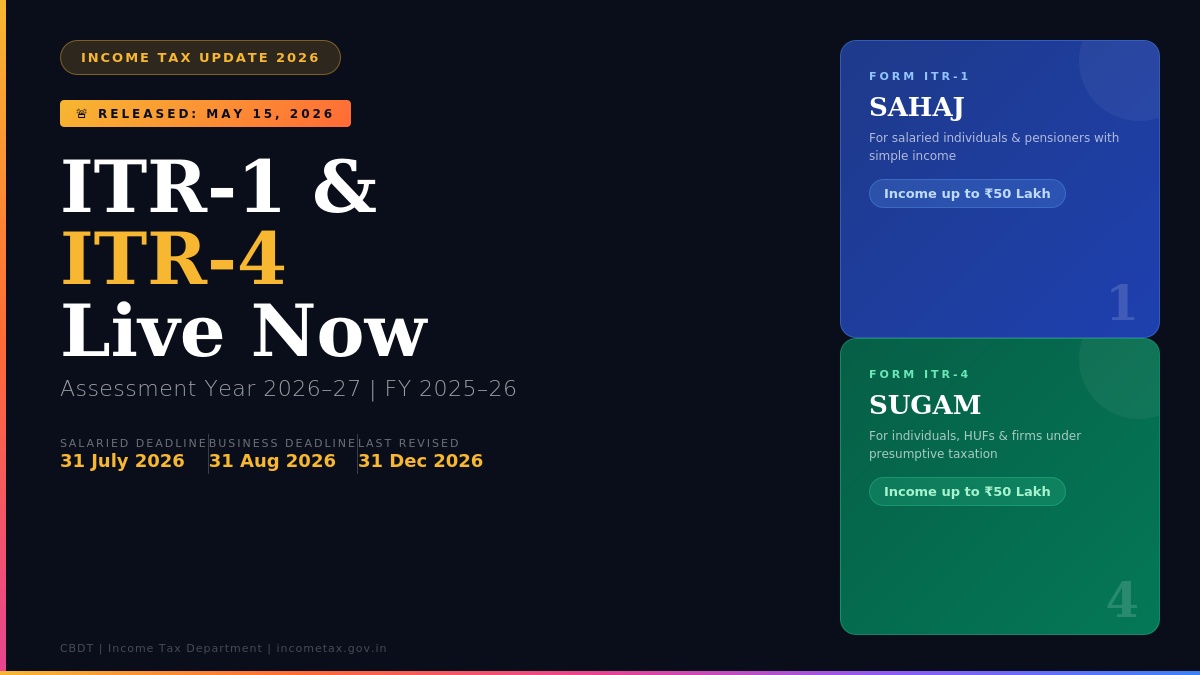
ITR-1 (Sahaj) & ITR-4 (Sugam) for AY 2026-27: Complete Guide - Who Can File, What's Changed & Consequences of Filing the Wrong Form
Assessment Year: 2026-27 | Financial Year: 2025-26
Released: May 15, 2026 | Filing Deadline: July 31, 2026 (Salaried) | August 31, 2026 (Business/Presumptive)
Introduction:
On May 15, 2026, the Income Tax Department kicked off the tax return filing season for FY 2025-26 (Assessment Year 2026-27) by releasing the Excel utilities for ITR-1 (Sahaj) and ITR-4 (Sugam) on the official e-filing portal. Both online filing and offline Excel utilities are now available for eligible taxpayers.
These two forms cover the largest number of individual taxpayers in India - salaried employees, pensioners, small business owners, freelancers, and those under the presumptive taxation scheme. Understanding which form applies to you, what has changed this year, and what happens if you choose the wrong one is critical to a smooth, penalty-free filing.
Part 1: ITR-1 (Sahaj) -Who Can File It?
What is ITR-1?
ITR-1, popularly known as Sahaj (meaning "simple" in Hindi), is the most basic income tax return form designed for resident individuals with straightforward income sources and modest earnings.
Eligibility Criteria -Who CAN File ITR-1?
You can file ITR-1 if all of the following conditions are met:
1. Residential Status: You are a Resident Indian (not "Not Ordinarily Resident" or NRI).
2. Total Income Limit: Your total annual income does not exceed ?50 lakh.
3. Income Sources Allowed:
- Income from Salary or Pension;
- Income from up to two House Properties (only if it's one self-occupied or let-out property no brought-forward loss from house property);
- Income from Other Sources such as interest on savings accounts, fixed deposits, family pension, dividends;
- Agricultural Income up to ?5,000;
- Long-Term Capital Gains (LTCG) under Section 112A (from listed equity shares or equity-oriented mutual funds) up to ?1.25 lakh (New for AY 2026-27)
Who CANNOT File ITR-1?
You are not eligible for ITR-1 if:
- You are a Non-Resident Indian (NRI) or "Not Ordinarily Resident".
- Your total income exceeds ?50 lakh.
- You are a Director in any company.
- You have invested in unlisted equity shares.
- You have income from business or profession.
- You have Short-Term Capital Gains (STCG) or LTCG exceeding ?1.25 lakh.
- You have brought-forward or carry-forward capital losses.
- You have income from more than two house properties.
- You have foreign assets or foreign income.
- TDS has been deducted under Section 194N (cash withdrawals).
- You are required to file under Section 139(1)(b) (high-value transaction filers).
Part 2: ITR-4 (Sugam) -Who Can File It?
What is ITR-4?
ITR-4, popularly known as Sugam (meaning "easy"), is designed for individuals, HUFs, and firms under the Presumptive Taxation Scheme. It allows taxpayers to declare income based on a prescribed percentage of their business turnover rather than maintaining detailed books of accounts.
Eligibility Criteria -Who CAN File ITR-4?
You can file ITR-4 if all of the following conditions are met:
1. Who can file: Resident Individuals, Hindu Undivided Families (HUFs), and Partnership Firms (other than LLPs).
2. Total Income Limit: Total income does not exceed ?50 lakh.
3. Business/Professional Income: Income computed under:
- Section 44AD ? Presumptive income for small businesses (turnover up to ?3 crore for digital transactions, ?2 crore otherwise);
- Section 44ADA ? Presumptive income for professionals (gross receipts up to ?75 lakh for digital transactions, ?50 lakh otherwise);
- Section 44AE ? Presumptive income for goods carriage businesses.
4. Other income allowed: Salary/pension, income from one house property, other sources (interest, dividends).
5. LTCG under Section 112A up to ?1.25 lakh -(New for AY 2026-27).
Who CANNOT File ITR-4?
You are not eligible for ITR-4 if:
- Your total income exceeds ?50 lakh.
- You are an NRI.
- You are a Director in a company.
- You have invested in unlisted equity shares.
- You have income from more than two house properties.
- You have Short-Term Capital Gains or LTCG exceeding ?1.25 lakh, or any brought-forward/carry-forward capital losses.
- You are required to maintain books of accounts under the Income Tax Act.
- TDS has been deducted under Section 194N.
- You have foreign assets or foreign income.
- Your business is an LLP (LLPs must use ITR-5).
Part 3: What Has Changed in AY 2026-27- Compared to AY 2025-26?
Changes Common to Both ITR-1 and ITR-4:
1. Two House Properties Now Allowed in ITR-1:
Previously, ITR-1 was restricted to taxpayers with income from only one house property. In AY 2026-27, ITR-1 has been expanded to include up to two house properties, making it accessible to a larger group of salaried individuals.
2. LTCG Inclusion in ITR-1 (Continued from AY 2025-26):
The inclusion of LTCG under Section 112A up to ?1.25 lakh first introduced in AY 2025-26 continues in AY 2026-27. Previously, even exempt LTCG required filing the more complex ITR-2. This remains a significant relief for small equity investors.
Note: If LTCG exceeds ?1.25 lakh, or if the taxpayer has any other capital gains, brought-forward losses, or STCG, they must switch to ITR-2 or ITR-3.
3. Revised Annual Value Calculation for House Property:
A new method for computing the Annual Value of house property has been introduced:
Annual Value = Gross Annual Rent ? Unrealized Rent ? Municipal Tax
Taxpayers can now deduct unrealized rent directly from gross rent when calculating annual value, bringing the form in line with practical rental realities.
4. Disclosure of Political Party Donations (Section 80GGC):
Taxpayers claiming deductions for donations to political parties must now provide:
- Name of the Political Party
- PAN of the Political Party
- Transaction Reference Number (UPI/Cheque/IMPS/NEFT/RTGS).
This mandatory disclosure improves traceability and cross-verification with party filings.
5. Share Buyback Loss Reporting:
A new field has been added to disclose losses from share buybacks (following the amendment treating buyback proceeds as dividend income in the hands of shareholders). This is a key transparency measure for equity investors.
6. Additional Capital Gains Reporting Fields:
There are enhanced and more granular fields for reporting LTCG under Section 112A, including details of the securities sold, date of acquisition, and whether gains are within or beyond the exemption threshold.
Changes Specific to ITR-4:
1. Mandatory Bank Balance Disclosure:
ITR-4 filers must now mandatorily report their closing bank account balance as of March 31, 2026. This is a significant new compliance requirement aimed at cross-verifying cash flows with income declared under presumptive taxation.
2. New "Investments" Field in Financial Particulars:
In the Financial Particulars of Business section, a new field called "Investments" has been added on the assets side. This enables better disclosure of the financial position of presumptive taxpayers.
3. Extended Filing Deadline for ITR-4
As per Budget 2026, the due date for ITR-4 filers (non-audit business taxpayers) has been changed to August 31, 2026, extended from the earlier July 31 deadline.
Part 4: Consequences of Filing the Wrong ITR Form:
Choosing the incorrect ITR form is one of the most common and potentially costly tax filing mistakes. Here is a comprehensive breakdown of what can go wrong:
1. Return Treated as Defective-Section 139(9):
If you file an ITR using an incorrect form, the Income Tax Department can declare it a defective return under Section 139(9). A defective notice requires you to:
- Refile the return in the correct form within 15 days of receiving the notice.
- Failure to respond means the return is treated as not filed at all.
Example: A freelancer with professional income files ITR-1 (eligible only for salaried individuals). The department can declare this defective and demand refiling under ITR-3 or ITR-4.
2. Return Treated as Invalid / Not Filed:
If the defective return is not corrected in time, or the form mismatch is serious enough, the return may be treated as though it was never filed. This has cascading consequences:
- Attracts penalty under Section 234F-?5,000 for income above ?5 lakh; ?1,000 for income below ?5 lakh.
- Loss of the right to carry forward losses (business, capital gains).
- Interest under Section 234A on taxes due.
3. Penalty for Under reporting Income -Section 270A:
When a simpler form (like ITR-1) is used where elaborate disclosures are required, it may lead to under reporting of income whether intentional or not.
- Underreporting Penalty: 50% of the tax amount on underreported income.
- Misreporting Penalty: 200% of the tax amount on misreported income.
Example: A taxpayer with LTCG of ?3 lakh files ITR-1 (which allows only up to ?1.25 lakh). The ?1.75 lakh unreported LTCG could trigger under reporting penalties.
4. Scrutiny and Income Tax Notices:
Filing the wrong form especially a simpler one that cannot capture all income details flags your return for scrutiny. The Assessing Officer (AO) can issue:
- Section 143(2) Notice ? scrutiny notice requiring explanation of income.
- Section 148 Notice ? reassessment notice if income is believed to have escaped taxation.
- These notices can go back up to 6 years in normal cases, and up to 10 years in cases involving income exceeding ?50 lakh.
5. Loss of Refunds and Carry-Forward Benefits:
- A wrongly filed return may delay or forfeit your refund.
- Capital losses cannot be carried forward if the return is not validly filed by the due date.
- Business losses also cannot be carried forward in a belated or invalid return.
6. Loan, Visa, and Financial Documentation Issues:
Banks, financial institutions, and visa authorities require properly filed ITRs as income proof. A defective or invalid return can:
- Delay home loan or business loan approvals.
- Cause visa rejections where income documentation is mandatory.
7. Prosecution in Extreme Cases:
Under Section 276CC of the Income Tax Act, wilful failure to furnish a return can result in prosecution with:
- Imprisonment of 3 months to 2 years for tax evasion below ?25 lakh.
- Imprisonment of 6 months to 7 years for tax evasion above ?25 lakh.
How to Correct a Wrongly Filed ITR?
If you realize you have filed the wrong form:
Step 1:Before receiving any notice: File a Revised Return under Section 139(5) using the correct form. This can be done up to December 31, 2026 for FY 2025-26.
Step 2: After receiving a defective notice (Section 139(9)): Respond to the notice within 15 days and refile using the correct form.
Step 3: After assessment: File an Updated Return (ITR-U) under Section 139(8A) within 2 years from the end of the relevant assessment year (with applicable additional tax payment).
Key Dates ? AY 2026-27
| Category | Due Date |
| ITR-1 (Salaried/Pensioners) | July 31, 2026 |
| ITR-4 (Business/Presumptive ? Non-Audit) | August 31, 2026 |
| Audit cases | October 31, 2026 |
| Belated / Revised Returns | December 31, 2026 |
Conclusion:
The Income Tax Department's release of ITR-1 and ITR-4 utilities on May 15, 2026 marks an important step in simplifying tax compliance for crores of Indian taxpayers. The key changes for AY 2026-27 expanding ITR-1 to cover two house properties, mandatory bank balance disclosure in ITR-4, enhanced capital gains reporting, and political donation transparency reflect the government's push for greater accuracy and accountability.
Filing the right form on time is not just a legal obligation it protects you from penalties, preserves your right to carry forward losses, secures faster refunds, and keeps you clear of scrutiny notices. When in doubt, consult a qualified Chartered Accountant before filing.
*Disclaimer: This article is for informational purposes only and is based on CBDT notifications and expert commentary available as of May 2026. Tax laws are subject to change. Consult a Expert tax professional of ComplyTax for personalized advice.
Written by
Team of Expert Professionals of ComplyTax Intelligent Solutions Private Limited




Comments (0)