 May 23 2026
 8 min read
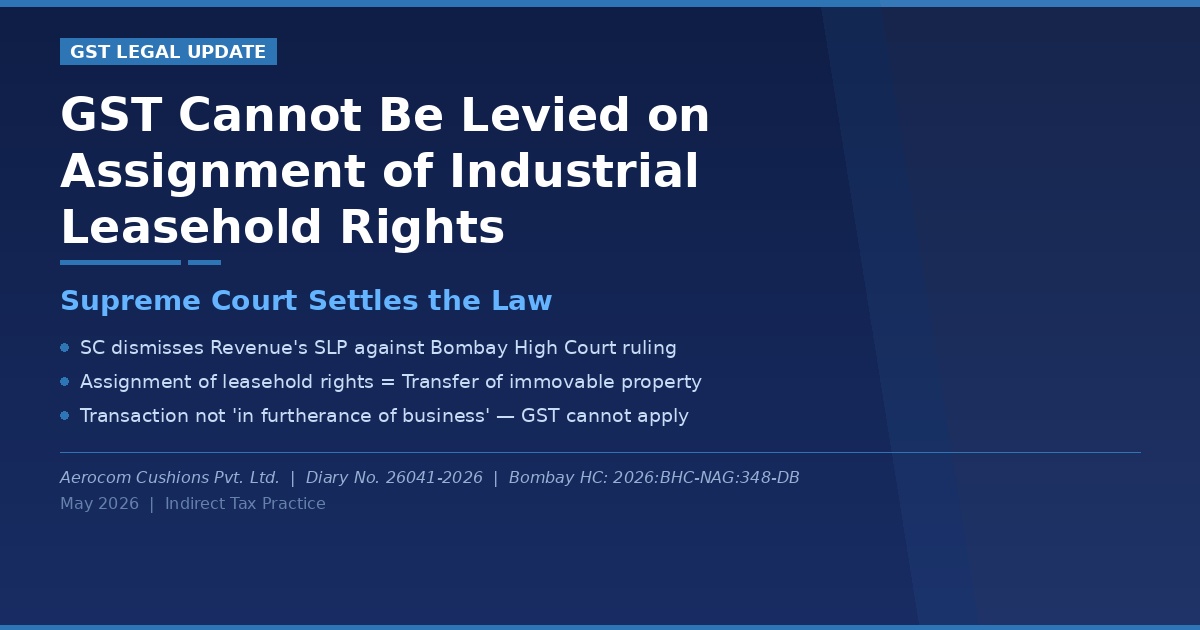
GST LEGAL UPDATE
GST Cannot Be Levied on Assignment of Industrial Leasehold Rights: Supreme Court Settles the Law
Case: Assistant Commissioner (Anti-Evasion) & Anr. v. Aerocom Cushions Private Limited Supreme Court of India | Diary No. 26041-2026 Affirming: Bombay High Court, WP No. 2145 of 2025, dated January 9, 2026 Outcome: Revenue's Special Leave Petition DISMISSED | HC ruling upheld |
Introduction:
A long-running dispute over whether Goods and Services Tax (GST) applies to the transfer of leasehold rights in industrial land has finally been settled by the Supreme Court of India. The Court dismissed the Revenue's Special Leave Petition, affirming the Bombay High Court's ruling that assignment of leasehold rights in industrial land does not attract GST.
The decision brings much-needed clarity to thousands of industrial units across India that hold plots allotted by state development corporations such as MIDC (Maharashtra), GIDC (Gujarat), and their equivalents in other states.
Background: How the Dispute Arose:
Aerocom Cushions Private Limited, a Nagpur-based manufacturing company, held a 95-year lease over an industrial plot allotted by the Maharashtra Industrial Development Corporation (MIDC). The company had constructed a factory building on the plot and subsequently assigned its entire leasehold rights to a third party, with prior MIDC approval and payment of the requisite transfer premium. The consideration received was ?1.50 crore.
The GST Anti-Evasion wing of CGST & Central Excise, Nagpur, issued a Show Cause Notice under Section 74(1) of the CGST Act, 2017, alleging:
? That the company had concealed a taxable transaction;
? That the assignment of leasehold rights constituted a supply of services under Section 7 read with Schedule II of the CGST Act; and
? That GST amounting to ?27,00,000 (approximately 18% on ?1.50 crore) should be recovered from the company.
The department classified the assignment under the residual entry of "other miscellaneous services" in Schedule II, treating it as a taxable service.
The Bombay High Court Ruling (January 9, 2026):
Aerocom Cushions challenged the Show Cause Notice by filing a Writ Petition (WP No. 2145 of 2025) before the Nagpur Bench of the Bombay High Court. A Division Bench of Justice Nivedita P. Mehta and Justice Anil L. Pansare ruled comprehensively in favour of the company.
1. Assignment ? Lease or Sub-Lease:
The Court held that an assignment of leasehold rights is legally distinct from a lease or sub-lease. When an assignor transfers all its leasehold rights, its own rights stand extinguished. A transaction where the transferor's rights are completely given up cannot be classified as a "lease" for GST purposes.
2. Transfer of Immovable Property ? Not a Supply of Services:
The assignment constituted a transfer of benefits arising out of immovable property. Benefits arising from immovable property fall outside the GST net, as such transactions are constitutionally within the domain of stamp duty, not GST.
3. The "In the Course or Furtherance of Business" Test:
This was the decisive legal point. Under Section 7 of the CGST Act, a transaction qualifies as a "supply" only if made in the course or furtherance of business. The Court found that the assignment of a long-term industrial lease ? a one-time, isolated, non-recurring transaction ? had no nexus with the company?s core business of manufacturing cushions. It was a property transaction, not a commercial activity.
4. Residual Entries Cannot Be Stretched:
The Court rejected the Revenue's attempt to classify the transaction under "other miscellaneous services" in Schedule II, holding that residual entries cannot be stretched to cover transactions that are fundamentally property transfers.
5. Reliance on Gujarat High Court Precedent:
The High Court followed the Gujarat High Court's ruling in Gujarat Chamber of Commerce and Industry v. Union of India (2025), which had examined a Central Tax Notification providing a zero-rate for one-time charges paid for long-term leases (exceeding 30 years) by state industrial development corporations, and had held similar assignments outside GST.
The Show Cause Notice was accordingly quashed.
The Supreme Court's Decision (May 2026):
The Revenue challenged the Bombay High Court's ruling before the Supreme Court. After hearing the Revenue's arguments, the Supreme Court dismissed the SLP ? declining to interfere with the High Court's order.
1. Upholding the "Furtherance of Business" Requirement:
During the hearing, the Supreme Court specifically asked the Revenue to demonstrate how the assignment of leasehold rights constituted a transaction in the course or furtherance of business. The Revenue was unable to establish this nexus. The Court held that absent this foundational element, no GST liability could arise.
2. Rejecting the "Wait for Gujarat HC Decision" Argument:
The Revenue urged the Court to await the outcome of the challenge pending against the Gujarat High Court ruling in the Gujarat Chamber of Commerce case. The Supreme Court rejected this, clarifying that each GST dispute must be examined on its own factual matrix and legal context. The pendency of another challenge cannot sustain a legally untenable demand.
3. Affirming Non-Taxability as a Principle:
By dismissing the SLP, the Supreme Court reinforced the principle that outright assignment of leasehold rights in industrial land is outside the scope of GST ? a position now affirmed at the apex judicial level.
Legal Framework: Why This Transaction Falls Outside GST:
The following table maps the key provisions that informed the courts? analysis:
| Element | Provision | Relevance | Relevance |
| Definition of "Supply" | Section 7, CGST Act | Requires transaction to be in course/furtherance of business | |
| Schedule II ? Deemed Supply | Para 2, Schedule II | Covers lease, tenancy, licence ? not outright assignment | |
| Immovable Property | Entry 5, Schedule III | Sale of land/building excluded from GST | |
| Long-term Lease Notification | Central Tax Notification (June 2017) | Zero-rate for one-time lease premium by state industrial corporations |
The courts have confirmed that an assignment transferring all leasehold rights ? extinguishing the assignor's interest entirely ? is closer in character to a sale of property rights than to a lease or service, and therefore cannot be taxed under GST.
Takeaways for Tax Professionals:
1. Advise Clients with Pending Show Cause Notices: This ruling provides strong grounds to challenge or seek quashing of GST show cause notices demanding tax on similar MIDC/GIDC plot assignments. File detailed replies citing both the Bombay HC ruling and the Supreme Court's dismissal of the SLP.
2. Document the Key Factual Elements: The characteristics that made this transaction non-taxable were: (a) a long-term lease of 95 years; (b) assignment of the entire leasehold rights; (c) prior approval of the development authority; (d) payment of transfer premium to the authority; and (e) no connection to the core business of the assignor. Ensure these facts are clearly documented.
3. Watch the "Furtherance of Business" Test: If a company regularly trades in leasehold rights as part of its business, the analysis could differ. The ruling protects one-time, isolated property assignments ? not systematic trading in leasehold interests.
4. Apply to Other State Development Corporations: The principle is not limited to MIDC. Similar assignments of plots allotted by GIDC (Gujarat), HSIIDC (Haryana), KIADB (Karnataka), SIPCOT (Tamil Nadu), and others should be equally protected. Section 7 of the CGST Act is uniform across India.
5. Review Refund Opportunities: If clients have already paid GST on such transactions, this ruling strengthens the basis for refund claims under Section 54 of the CGST Act, subject to limitation periods. Review past compliance immediately.
6. Consider Advance Ruling Applications: For upcoming assignments, consider filing for an Advance Ruling to obtain jurisdiction-specific clarity, while citing this Supreme Court-affirmed position as persuasive authority.
Takeaways for Taxpayers:
The law is now clearly on your side. Do not pay without contesting. Engage a tax professional to file a reply citing Aerocom Cushions and seek withdrawal or quashing of the notice.
You are not required to charge or pay GST on the transaction, provided the assignment is a one-time transfer of your entire leasehold interest with the development authority's approval. Maintain all documentation ? lease deed, assignment agreement, MIDC/GIDC approval letter, and premium payment receipts.
Consult your tax advisor immediately about a refund claim. The window for refund under GST law is typically two years from the date of payment.
If GST was charged to you, the seller may be able to claim a refund. Examine whether Input Tax Credit was availed, and ensure compliance records are in order.
Conclusion:
The Supreme Court's dismissal of the Revenue's SLP in Assistant Commissioner (Anti-Evasion) v. Aerocom Cushions Private Limited brings finality to a question that has troubled industrial businesses for years. The ruling confirms a straightforward but important principle: a genuine transfer of immovable property rights is not a taxable supply under GST, and the state cannot use residual service classifications to tax what is, in substance, a property transaction.
For businesses that received aggressive GST notices from Anti-Evasion wings since GST's introduction in 2017, this ruling is both a legal vindication and a practical shield. Tax professionals should act promptly to protect clients still fighting similar demands, and businesses should audit past transactions for potential refund opportunities.
The order copy is still awaited. Once available, it will be worth examining closely for the Supreme Court's precise reasoning ? which may offer additional formulations useful in analogous disputes.
Disclaimer: This article is for informational purposes only and does not constitute legal or tax advice. Readers are advised to consult a qualified tax professional for advice specific to their circumstances.




Comments (0)