 Jul 18 2026
 5 min read
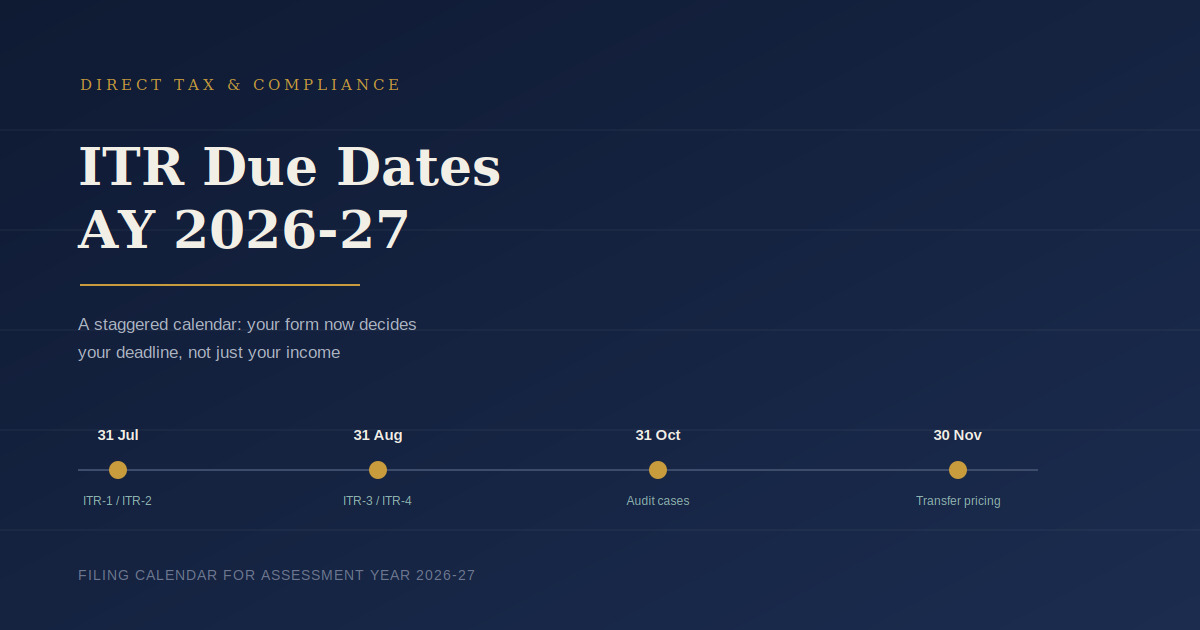
For years, most taxpayers only had to remember one date, 31 July. That's no longer true. Starting this assessment year, the due date depends on which ITR form applies to you, and Budget 2026 has introduced a genuine staggering of deadlines rather than one common cutoff for everyone. Here's a clear breakdown of what's due when.
This remains the deadline for individuals and entities that don't require a tax audit and typically file ITR-1 or ITR-2. This covers:
If this is your category, 31 July 2026 remains your operative deadline, exactly as it has been in past years.
This is the genuinely new development for AY 2026-27. Previously, business and professional taxpayers not subject to audit still had to file by 31 July along with everyone else. Budget 2026 has now carved out an extra month for this group, so taxpayers filing ITR-3 or ITR-4 without a mandatory audit requirement get until 31 August 2026. This includes:
The stated rationale behind the extra month is to give this category more breathing room to close their books and complete reconciliations, something salaried taxpayers with straightforward Form 16 income don't need as much time for.
This date matters specifically for entities whose accounts require a statutory audit. The Tax Audit Report itself, filed by the auditor rather than the taxpayer, is due one month ahead of the return filing deadline for audit cases. So if you fall into the audit category below, your auditor's report needs to be filed by 30 September 2026, ahead of your own return.
This is the general due date for taxpayers whose books of account are required to be audited under the Income Tax Act. It applies to:
Taxpayers who have entered into international transactions or specified domestic transactions requiring a transfer pricing report under Section 92E get the longest runway, until 30 November 2026. This category typically covers larger businesses and multinational entities with related-party cross-border dealings.
Missing your applicable due date doesn't mean you're locked out of filing, but it does come with costs.
Belated return. You can still file until 31 December 2026 as a belated return. This attracts a late filing fee under Section 234F, up to ₹5,000 depending on your income level, along with interest on any unpaid tax under Section 234A. A more significant consequence is that filing late generally forecloses your ability to opt for the old tax regime for that year; you'll be taxed under the new regime by default, losing access to deductions such as 80C, 80D, HRA, and home loan interest under Section 24(b).
Revised return. If you've already filed on time but discover an error or omission, Budget 2026 has extended the window to file a revised return from the earlier 31 December cutoff to 31 March 2027. This gives taxpayers a genuinely longer runway to correct mistakes discovered after the fact, whether due to a late Form 16 correction, updated Form 26AS, or a mismatch in the Annual Information Statement.
Updated return (ITR-U). For taxpayers who miss filing altogether or later discover undisclosed income, the updated return facility remains available for up to four years from the end of the relevant assessment year. For AY 2026-27, that puts the outer limit for filing an ITR-U at 31 March 2031, though filing later within that window typically means paying additional tax as a penalty for the delay.
| Category | Due Date |
|---|---|
| Salaried, pensioners, ITR-1/ITR-2 filers (no audit) | 31 July 2026 |
| Business/professional, ITR-3/ITR-4, no audit required | 31 August 2026 |
| Tax Audit Report filing | 30 September 2026 |
| Accounts requiring statutory audit | 31 October 2026 |
| Transfer pricing report cases (Section 92E) | 30 November 2026 |
| Belated return | 31 December 2026 |
| Revised return | 31 March 2027 |
| Updated return (ITR-U) | 31 March 2031 |
The single biggest change this year is that your ITR form, not just your income level, now determines your deadline. A salaried employee and a freelancer with identical income levels now file a month apart. Given that filing late costs you both money under Section 234F and the option to use the old tax regime, it's worth confirming which ITR form applies to you early, rather than assuming 31 July is your date by default.
By
Team of Tax Experts of ComplyTax Intelligent Solutions Private Limited
Note: Due dates are subject to further extension by CBDT notification, as has happened in past assessment years. It's worth checking the Income Tax Department's official portal closer to the deadline for any last-minute changes.




Comments (0)