 Jul 18 2026
 7 min read
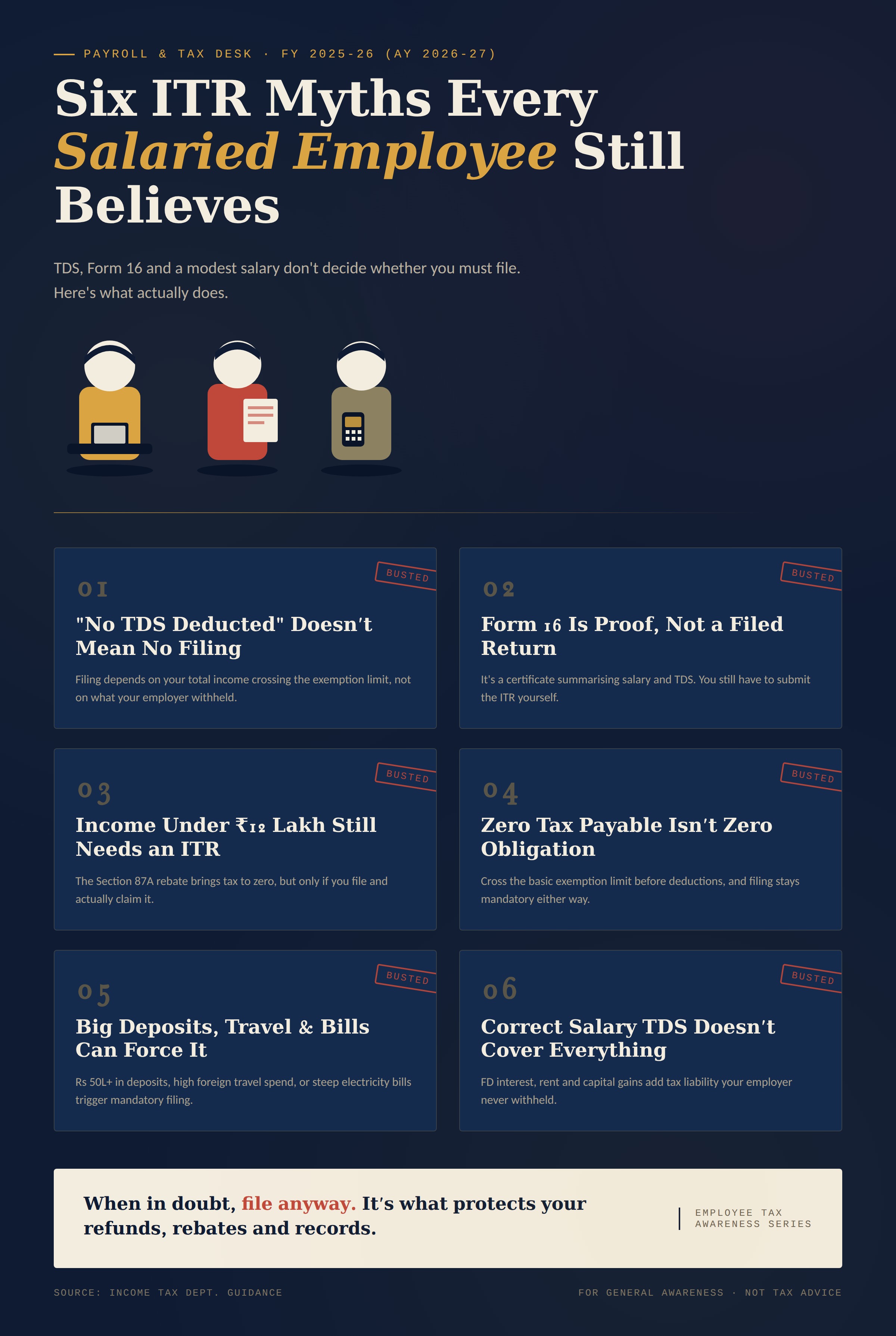
Every tax season, the same set of doubts resurfaces among salaried employees in India. "No TDS was deducted, so I don't need to file." "I have Form 16, so I'm covered." "My income is under 12 lakh, so filing doesn't apply to me." These beliefs feel logical on the surface, but none of them hold up against the actual rules. Here is a clear breakdown of the most common misconceptions, and what the law actually says.
This is probably the single most repeated myth, and it rests on a basic mix-up. Whether tax was deducted at source has nothing to do with whether you are required to file a return. Your obligation to file depends on your gross total income for the year, not on what your employer or bank withheld.
Under the current tax framework, the basic exemption limit for individuals is Rs 3 lakh. Cross that limit, and filing becomes mandatory, regardless of whether a single rupee of TDS was ever deducted from your salary. Employers sometimes skip TDS because your declared investments and deductions bring your projected tax to zero, but that projection is not the final word. You still need to file your own return to confirm the position.
Form 16 is often mistaken for the return itself. It is not. It is simply a certificate your employer issues, summarising the salary paid to you and the tax deducted during the year. It comes in two parts: Part A, which covers PAN, TAN, and TDS deposited with the government, and Part B, which lays out your detailed salary structure, exemptions, and deductions.
Think of Form 16 as raw material, not the finished product. You still need to take that information and actually submit your ITR on the income tax portal. Possessing the certificate changes nothing about your filing requirement.
This is the flip side of the first myth, and it is equally incorrect. Even if your employer never issues a Form 16 because no tax was withheld, you can still file your return using alternative documents. Salary slips, Form 26AS, the Annual Information Statement (AIS), and your bank statements all serve as valid substitutes. Missing paperwork from your employer simply means you assemble your income proof from other sources. It does not excuse you from filing.
This has become the most widespread misunderstanding since the newer tax regime introduced a larger rebate. Under the new regime, salaried individuals can end up with zero tax liability on income up to roughly Rs 12.75 lakh, once the standard deduction and the Section 87A rebate are applied. But zero tax liability is not the same as zero filing obligation.
Here is the part most people miss: the Section 87A rebate is not automatic. It only gets applied when you file your return and claim it. Skipping the filing because "there's no tax anyway" can mean walking away from a benefit you were entitled to, simply because you never claimed it through the proper channel.
Filing requirements are tied to your income crossing the exemption threshold, not to whether any tax ends up being owed. Plenty of taxpayers land at zero final tax after deductions and rebates, and are still legally required to file because their gross income exceeded the limit before those deductions kicked in. Treating "zero tax" and "no filing needed" as the same thing is a costly assumption, since non-compliance can still trigger penalties even when nothing was actually owed.
Income level is not the only trigger for mandatory filing. Several other conditions override the exemption limit entirely:
If any of these apply to you, filing becomes compulsory regardless of how low your income actually is.
Filing an ITR is worth more than just chasing a refund. A filed return, even a nil one, acts as verified proof of income and address, which matters when applying for a passport, a visa, or a loan. Banks routinely ask for ITRs as part of income verification. Filing also lets you carry forward capital losses to offset against future gains, a benefit you permanently lose if you skip filing in the year the loss occurred.
Salary TDS is designed to cover your salary income, not everything else you might earn. Interest from savings accounts and fixed deposits, rental income, bonds, and capital gains all add to your total tax liability separately. If the additional tax from these sources crosses Rs 10,000 in a year, you're required to pay advance tax in quarterly instalments. A clean salary TDS deduction says nothing about whether your other income has been accounted for.
Avoiding filing does not resolve a mismatch, it just delays the problem. The tax department relies on Form 26AS to grant TDS credit, and if the figures there don't match what's on your Form 16, the safer move is to flag the discrepancy with your employer or the deductor and get it corrected before filing, not to skip the return altogether.
This is a newer trap catching more salaried employees. Even when TDS on your salary was calculated and deducted correctly by your employer, it can still fall short of your actual total liability once your full financial picture is put together at filing time. This gap often shows up only when the return is being prepared, by which point interest may already be accruing. The safer approach is to periodically estimate your total annual income yourself, rather than assuming payroll deductions have already settled everything.
Almost every one of these myths comes from treating TDS, Form 16, or a low income figure as a stand-in for the actual filing rule. None of them are. The rule is simple even if the myths around it aren't: if your gross income crosses the exemption threshold, or you meet any of the special conditions around deposits, spending, or business income, you are required to file, no matter what has or hasn't been deducted along the way. Filing is also frequently the only way to actually access benefits like the Section 87A rebate or a TDS refund, so skipping it on the assumption that "there's nothing to gain" often works against your own interest.
By
Experts Team of ComplyTax Intelligent Solutions Private Limited
This article is for general awareness only and does not constitute tax advice. For decisions specific to your situation, consult a Tax Expert of ComplyTax or refer to the Income Tax Department's official guidance.




Comments (0)