 Jun 05 2026
 5 min read
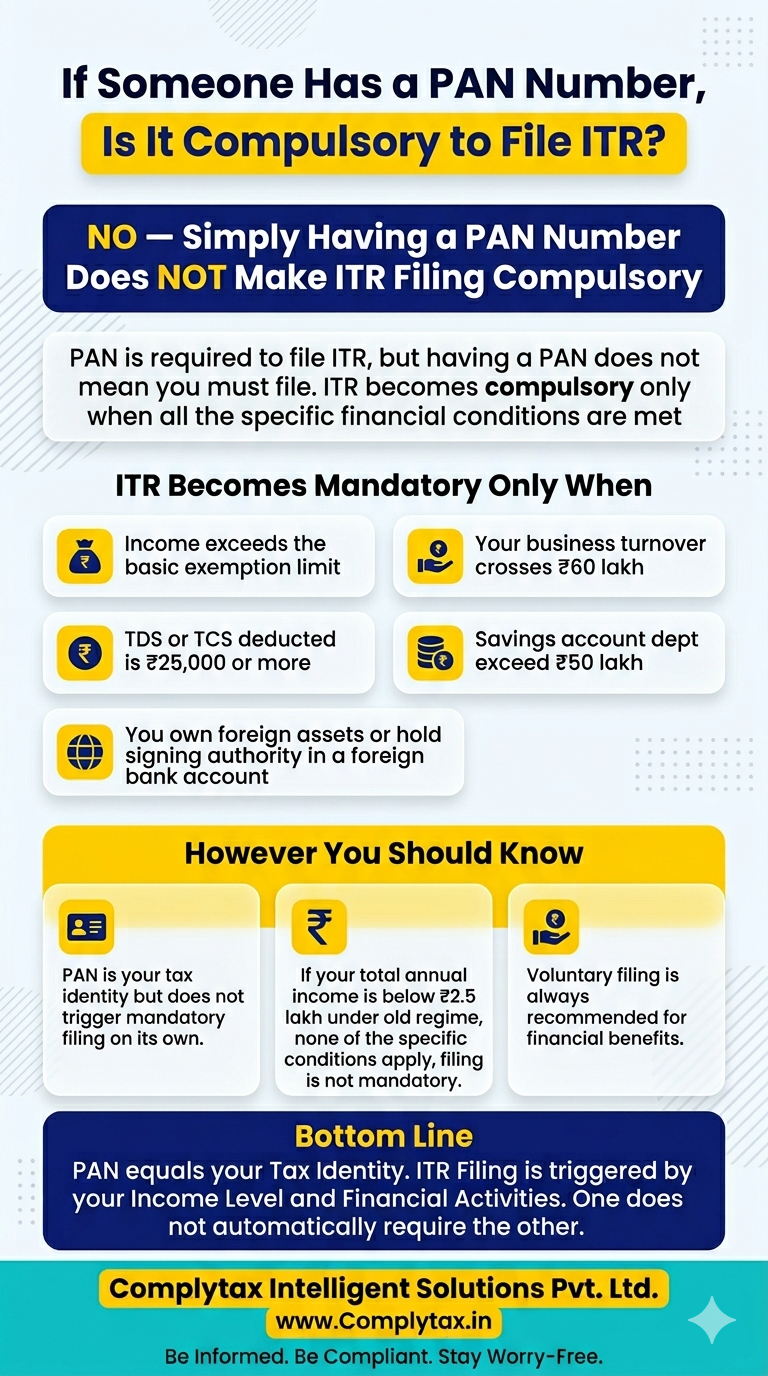
No. Simply having a PAN card does NOT make ITR filing compulsory. Your PAN number is just your tax identity ? it is used to track your financial transactions, link your investments, and correspond with the Income Tax Department. But it does not automatically create an obligation to file your Income Tax Return. ITR filing becomes compulsory only when your income crosses the basic exemption limit under whichever tax regime you are under, or when you fall into one of the specific mandatory conditions defined under the Income Tax Act, 1961.
For AY 2026-27, the ITR for income earned during FY 2025-26 will be filed under the provisions of the Income Tax Act, 1961. The new Income Tax Act 2025 does not apply to this year's filing. The new provisions will only come into play for income earned in tax year 2026-27, with filings due in 2027. So everything explained below is fully governed by the existing Income Tax Act, 1961.
The Old Tax Regime allows you to claim a wide range of deductions and exemptions. Under the old tax regime, more than 70 exemptions and deductions such as HRA and LTA are available which decrease your taxable income and consequently lessen your tax obligations.
Under this regime, the basic exemption limits for AY 2026-27 are as follows. For individuals below 60 years of age, the basic exemption limit is ?2.5 lakh. For senior citizens between 60 and 79 years of age, it is ?3 lakh. And for super senior citizens who are 80 years or above, it is ?5 lakh.
This simply means that if your total income after claiming all your deductions and exemptions falls below these limits, ITR filing is NOT mandatory for you under the old regime, even if you have a PAN card. Additionally, Section 87A allows individuals to claim a rebate of ?12,500 under the old tax regime, which effectively makes income up to ?5 lakh tax-free. However, please note that even if your tax liability becomes zero due to this rebate, if your gross income has crossed ?2.5 lakh, filing is still mandatory.
The New Tax Regime is now the default regime for all taxpayers in India for AY 2026-27. The new tax regime is the default option for individuals and HUFs. Taxpayers, however, retain the choice to opt out and continue under the old tax regime.
Under the new tax regime, the basic exemption limit is ?4 lakh. Taxable income up to ?12 lakh becomes effectively tax-free thanks to a ?60,000 rebate under Section 87A, and for salaried employees it goes up to ?12.75 lakh due to the standard deduction benefit.
This means that if your total income is below ?4 lakh under the new regime, ITR filing is NOT mandatory. However, if your income is anywhere between ?4 lakh and ?12 lakh, your tax liability may be zero due to the Section 87A rebate, but ITR filing IS still mandatory because your income has already crossed the basic exemption limit of ?4 lakh. This is one of the most common misunderstandings among taxpayers.
Also, deductions under Chapter VI-A, including popular ones like 80C for investments and 80D for health insurance, cannot be availed under the new tax regime. So if you have significant investments or deductions to claim, you may want to evaluate whether the old regime benefits you more.
This is something that confuses a lot of people. Just because you do not owe any tax does not mean you are exempt from filing your ITR. Exemption from tax does not always mean exemption from filing ITR. The moment your income crosses the basic exemption limit, which is ?2.5 lakh under the old regime or ?4 lakh under the new regime, you are required to file your ITR regardless of whether any tax is actually payable or not.
Yes, with some conditions. For taxpayers without business income, the regime can be chosen annually while filing the ITR within the due date under Section 139(1). For those with income from business or profession, to opt for the old tax regime they must file Form 10-IEA before the due date. So if you are a salaried individual or have only investment income, you have the flexibility to choose either regime every year based on which one benefits you more.
Absolutely yes. Even if your income is below the exemption limit and filing is not mandatory for you, voluntarily filing your ITR has several practical benefits. It serves as a strong proof of income for bank loans, home loans, and credit cards. Foreign embassies like the USA, UK, Canada, and Schengen countries ask for 2 to 3 years of ITR as financial proof during visa applications. It also helps you claim back any TDS that may have been deducted from your bank interest or other income. Regular ITR filing builds your financial credibility and keeps you protected from future income tax notices and scrutiny.
Your PAN card is your tax identity, nothing more. ITR filing is determined by your income level and specific financial activities, not by the mere possession of a PAN number. If your income is below ?2.5 lakh under the old regime or below ?4 lakh under the new regime, and none of the 12 mandatory conditions apply to you, then filing is not compulsory. But it is always in your best interest to file voluntarily, stay compliant, and keep your financial record clean.
? Due Date for AY 2026-27 ? For salaried individuals, the last date to file ITR is 31st July 2026. For businesses and professionals not under audit, the deadline is 31st August 2026.




Comments (0)